erica harris likes to make art.
Resume
Artist Statement
I live in Brooklyn, New York. The history, debris, languages, and industries of my metropolis are a huge source of materials and inspiration. I also teach art to children, both here and internationally. In recent years I have facilitated projects in India, Guatemala, Macedonia, Brazil, El Salvador, Southeast Asia, and Brooklyn. These settings have had a profound influence on my work, and the collaborations with children have been extremely rewarding exchanges. I learn as much, if not more, from looking at children's art and talking with them about their process and ideas as I do from the museums and galleries of New York. Using art as a tool to outline and interpret their relationships to family, school, work, play, death, violence, society, and the environment, I am provided with such a simple visual vocabulary, so eloquent and universal. Working in collaboration with communities where English is not spoken has also shaped the content of my work, particularly my relationship to language. I like using text; I use the printed word as a pattern, and I often refer to how words and images are interchangeable symbols. The story of the 20th century as told through an English as a Second Language primer is one I am compelled to cut up and re-tell. The basic sentences found in these elementary grammar books narrate customs, historic events, and approaches to everyday life in poetic ways that no history textbook has outlined. While traveling, I concentrate on collecting collage material: old children's encyclopedias and alphabet books, found photographs, sewing patterns, maps, deeds, gravestone rubbings, diagrams and instructional manuals, mid-century magazine advertisements, medicine labels, food packaging, candy wrappers, string, thread, notions, ritual charms, prayer cards, game pieces and other ephemera. I incorporate what I find and see in the streets, neighborhoods and marketplaces into the narratives of my pieces: people carrying towers of goods on their heads, toys constructed from tin cans and old bottles, houses and bird-feeders made of corroding metal bomb carcasses. In these countries that have been so damaged by years of war and poverty, I became fascinated by how everyday experiences and ordinary objects related to destruction, chaos, immigration, memory, survival and loss. Something very mundane and ordinary could be a symbol of safety, shelter, or peace, while simultaneously being a relic of war. It is in this context that I am drawn to the use of simple imagery: an airplane, a house, water, shoes, birds. Combining discarded materials to make these narratives, such as a schoolgirl with a dress quilted from teabags, or a nest of old road maps, is like creating a shrine, or providing a sanctuary for people, places and objects that need mending.
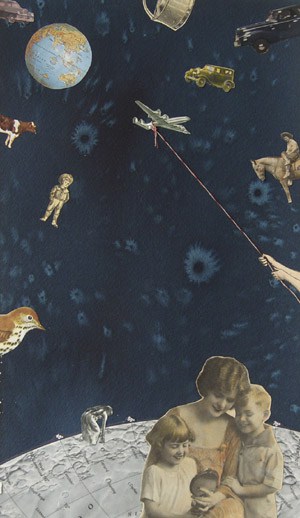
songs from the book of knowledge: moon

listen to moon

The mind of man can hardly conceive that life has ever been upon the moon, but as we look at this silent world and see with our own eyes the mighty record of its past, we feel a sense of the boundless mystery of the universe.
We stand on a world of life and look on a world of death.
We see spread out before us, in the full light of the sun, a landscape as vast as the American continent, with not a living thing upon it.
Not a flower blooms, not a tree grows, not an insect creeps, not a sound is heard, not a thing moving; the silence of a thousand ages is unbroken in this solitude that no man knows.
But it was not always thus.
The energies let loose in the world war were like children’s toys compared with the forces that must have once rent and torn the moon.
Unthinkable forces have made her what she is – beautiful to look upon as she rides in majesty with the Earth around the sun, but with a face all scarred and worn with time, and the mark of some great agony written over it.
Who is not moved by that picture of the moon which Professor J.A. Thomson has given us?
We may say of the moon, in his words, that “it was Earth’s only child, and it died.”

Note: The words in all Songs from the Book of Knowledge are excerpts taken from a 1939 Compton’s Pictured Encyclopedia and Fact-Index.

Reply

You must be logged in to post a comment.